
Why Attorneys Should Consider Mediation Before Litigation
Just-Mediate
In today’s legal and business environment, clients are increasingly looking for solutions that resolve disputes efficiently, cost-effectively, and with as little disruption as possible. While litigation remains an essential avenue for certain matters, mediation has become an increasingly valuable tool for attorneys seeking practical outcomes for their clients.
The most successful dispute resolutions often occur not in a courtroom, but around a mediation table where parties have the opportunity to engage in meaningful discussions and explore mutually beneficial solutions.

What Is Mediation?
Mediation is a structured, confidential process in which an independent and impartial mediator assists parties in resolving disputes through facilitated negotiation. Unlike a judge or arbitrator, the mediator does not impose a decision. Instead, the parties retain control over the outcome and work towards a voluntary agreement.
This process can be used in a wide range of matters, including:
- Commercial disputes
- Contract disagreements
- Partnership and shareholder conflicts
- Property disputes
- Employment matters
- Family and inheritance disputes
- Neighbour and community conflicts
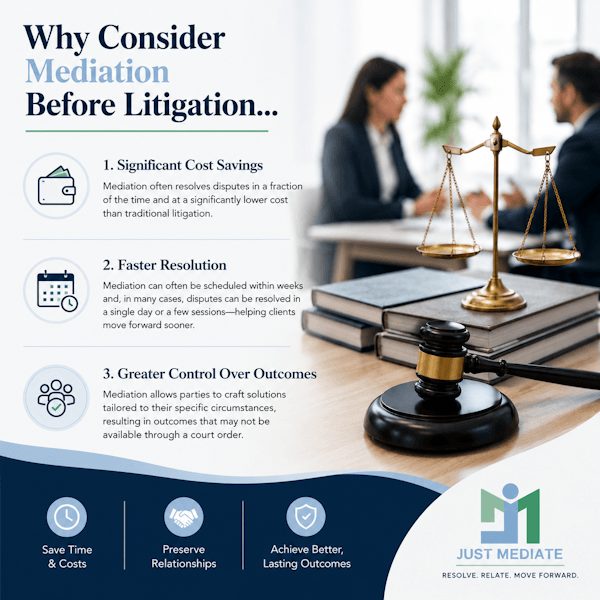
Why Consider Mediation Before Litigation?
- Significant Cost Savings
One of the primary concerns for clients involved in disputes is the escalating cost of litigation. Legal fees, expert reports, court appearances, and prolonged proceedings can place substantial financial pressure on all parties involved.
Mediation often allows disputes to be resolved in a fraction of the time and at a significantly lower cost than traditional litigation, providing clients with a more affordable path to resolution.
- Faster Resolution
Court proceedings can take months or even years before reaching a final outcome. During this time, disputes continue to consume valuable resources and create uncertainty.
Mediation can often be scheduled within weeks and, in many cases, disputes can be resolved in a single day or a few sessions. This allows clients to move forward sooner and focus on their personal or business objectives.
- Greater Control Over Outcomes
In litigation, the final decision rests with the court. Even a strong case carries uncertainty, and outcomes may not fully satisfy either party.
Mediation allows parties to craft solutions tailored to their specific circumstances. This flexibility often results in outcomes that would not be available through a court order.
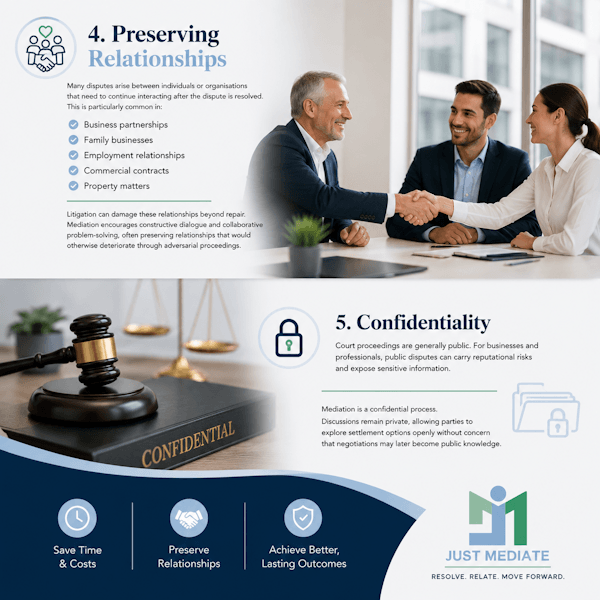
Why Consider Mediation Before Litigation?
- Preserving Relationships
Many disputes arise between individuals or organisations that need to continue interacting after the dispute is resolved. This is particularly common in:
- Business partnerships
- Family businesses
- Employment relationships
- Commercial contracts
- Property matters
Litigation can damage these relationships beyond repair. Mediation encourages constructive dialogue and collaborative problem-solving, often preserving relationships that would otherwise deteriorate through adversarial proceedings.
- Confidentiality
Court proceedings are generally public. For businesses and professionals, public disputes can carry reputational risks and expose sensitive information.
Mediation is a confidential process. Discussions remain private, allowing parties to explore settlement options openly without concern that negotiations may later become public knowledge.
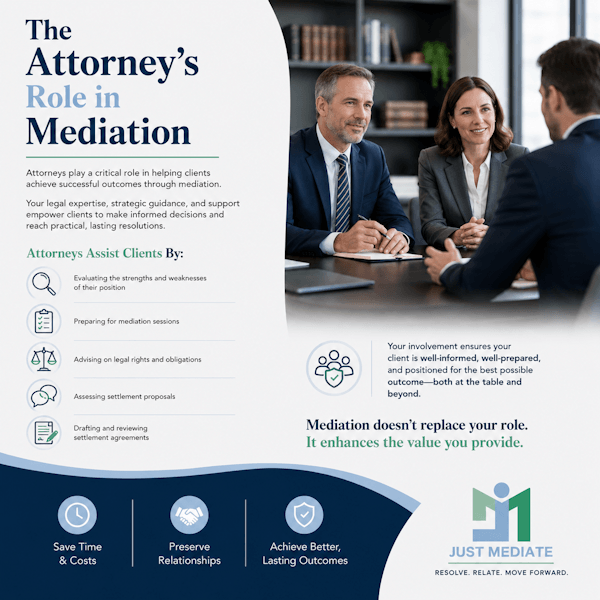
The Attorney's Role in Mediation
Some legal practitioners mistakenly view mediation as a substitute for legal representation. In reality, attorneys play a critical role throughout the mediation process.
Attorneys assist clients by:
- Evaluating the strengths and weaknesses of their position
- Preparing for mediation sessions
- Advising on legal rights and obligations
- Assessing settlement proposals
- Drafting and reviewing settlement agreements
Rather than diminishing the attorney’s role, mediation often enhances the value attorneys provide by helping clients achieve practical and commercially sensible outcomes.
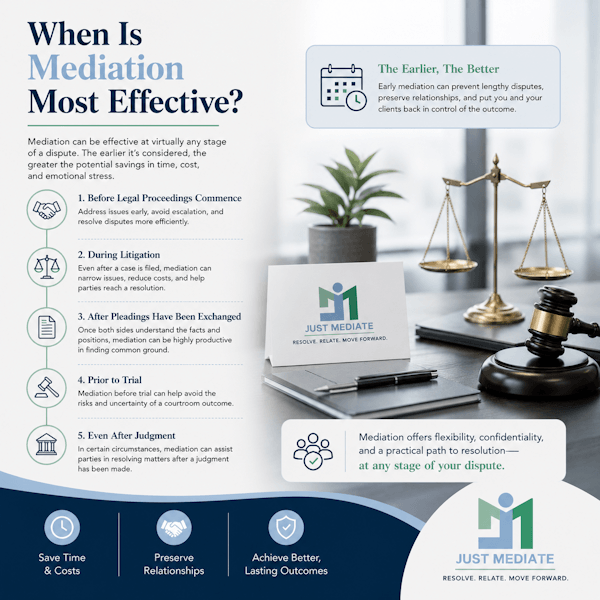
When Is Mediation Most Effective?
Mediation can be effective at virtually any stage of a dispute, including:
- Before legal proceedings commence
- During litigation
- After pleadings have been exchanged
- Prior to trial
- Even after judgment in certain circumstances
However, the earlier mediation is considered, the greater the potential savings in time, cost, and emotional stress.

A Better Outcome for Clients
Clients rarely approach attorneys seeking conflict for its own sake. Most are looking for certainty, closure, and a solution that allows them to move forward.
By considering mediation at an early stage, attorneys can often help clients achieve these goals while reducing costs, preserving relationships, and maintaining greater control over the outcome.
Mediation is not appropriate for every dispute. However, for many matters, it represents an effective first step that deserves serious consideration before embarking on lengthy and costly litigation.
Partner with Just Mediate
At Just Mediate, we work alongside attorneys, business professionals, and their clients to facilitate constructive discussions and achieve practical resolutions.
If you are an attorney, accountant, financial advisor, HR professional, or business consultant seeking an efficient dispute resolution option for your clients, we invite you to contact us to discuss whether mediation may be appropriate for a particular matter.
Early conversations can often prevent lengthy disputes. The best time to explore mediation may be before litigation begins.
GAUTENG MEDIATION DIRECTIVE AND PROTOCOL
Frequently Asked Questions About Mediation
Mediation is a voluntary and confidential dispute resolution process in which an independent and impartial mediator assists parties in reaching a mutually acceptable agreement. Unlike a judge or arbitrator, the mediator does not make decisions or impose outcomes. Instead, the parties remain in control of the final resolution.
The mediation process itself is not binding. However, once the parties reach an agreement and sign a settlement agreement, that agreement may become legally binding and enforceable, depending on the circumstances and applicable laws.
Mediation can be considered at almost any stage of a dispute. It may take place before legal proceedings begin, during litigation, after pleadings have been exchanged, before trial, or even after judgment in certain circumstances. In many cases, the earlier mediation is considered, the greater the potential savings in time, cost, and stress.
Yes. Attorneys play an important role in the mediation process by advising clients on their legal rights and obligations, helping them prepare for mediation, evaluating settlement proposals, and assisting with the drafting and review of settlement agreements. Mediation does not replace legal representation—it complements it.
Yes. Mediation is generally a confidential process. Discussions, negotiations, and settlement proposals made during mediation are typically not disclosed outside the process. This confidentiality allows parties to communicate openly and explore possible solutions without concern that their discussions may later become public knowledge.
Mediation can be effective in resolving a wide range of disputes, including commercial disputes, contract disagreements, partnership conflicts, employment matters, family business disputes, property disputes, inheritance matters, and community conflicts.
The duration of mediation depends on the complexity of the dispute and the willingness of the parties to negotiate. Many disputes can be resolved in a single mediation session, while more complex matters may require multiple sessions.
Many parties choose mediation because it is typically faster, more cost-effective, confidential, and allows them greater control over the outcome. Mediation also helps preserve important personal and professional relationships that may be damaged through adversarial court proceedings.
Book an Appointment
Kindly supply the information below. We will respond as soon as possible.